Trade War
Newsletter 293 - Feb. 22, 2026
Welcome to the 293rd edition of Trade War.
International Monetary Fund issues report critical of China’s growth model, calling its trade surplus “excessively large” and saying yuan is 16% undervalued. The international financial agency estimates Chinese state industrial subsidies amount to 4% of GDP, more than twice that of EU. And the IMF calls the shift to a consumption-led economy an “overarching priority.”
Supreme Court ruling on tariffs is likely to weaken Trump’s bargaining power with Xi Jinping when the American president visits Beijing. And additional purchases of American soybean by China now may not happen, predict analysts.
Exports from the Los Angeles Port fall 8% in January, driven in part by declining agricultural sales to China. Trump says he consulted with Xi on Taiwan arms sales, a striking concession to the Chinese leader. And is the American president considering allowing Chinese electric vehicle makers to manufacture in the US?
Notable/In depth ~
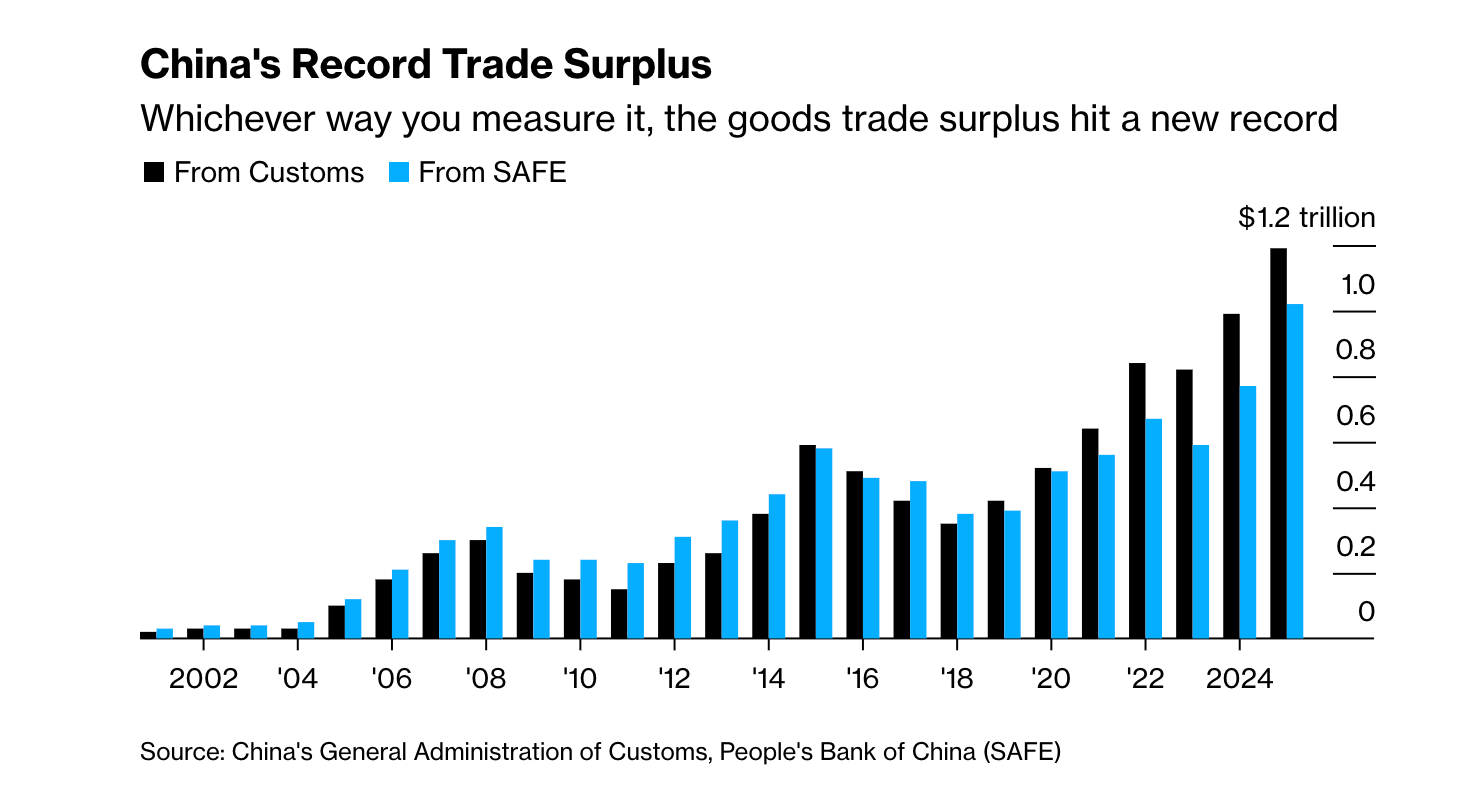
China surplus grows despite global trade defense measures
China has edge over US in pushing robots into real-world use
Despite predictions of its demise, Belt and Road Initiative is still going strong
The IMF criticizes China’s growth model
The International Monetary Fund has issued a report critical of China’s growth model, highlighting its reliance on exports and subsidies. The tough line is quite unusual for the Fund, which tends to couch its words when critiquing major economies.
What triggered the IMF’s harsh words? China’s record $1.2 trillion trade surplus last year is certainly a factor. The Fund estimates that China’s overall current account surplus is 3.3 percent of GDP. That is more than double the 1.5 percent the IMF had projected in its 2024 report.
The IMF called that figure “excessively large” and warned it was causing “adverse spillovers to trading partners.” With almost a third of growth last year from net exports, China’s growth model has “triggered overcapacity concerns” that could spur trade retaliation from other countries and “put China’s exports at risk,” the Fund said.
Exports from China are getting a boost from “real depreciation” of the yuan, the IMF said, noting that it believes the Chinese currency is 16 percent undervalued.
The IMF also cast a critical eye on China’s use of industrial subsidies. It said state support for priority sectors including robotics, electric vehicles, and green energy, amounted to about 4 percent of GDP in 2023. While conceding that it’s hard to do cross-country comparisons, the Fund put EU subsidies at only 1.5 percent.
The report used the phrase “external imbalances” more than 10 times; those words were not mentioned at all in the 2024 edition. Reflecting the Fund’s serious concern with China’s dropping prices, the report used the words “deflation” or “deflationary” more than 60 times.
China needs more expansionary policies, the IMF told Beijing. It also needs to find ways to boost its ailing property sector in order to “rebuild consumer confidence.” Most importantly, the country must change its growth model, which “requires significant cultural and economic policy transformation,” the Fund said.
China’s representative to the IMF executive board disagreed with the critical assessment, perhaps not surprisingly. Zhengxin Zhang said that China’s high export growth in 2025 was due to competitiveness and innovation, not subsidies or a depreciating yuan. Zhang also said the surge in overseas shipments was partly driven by front-loading by Chinese firms trying to get ahead of U.S. tariffs.
The timing of the IMF report is important, coming as it does, just weeks before the National People’s Congress will announce China’s GDP growth target for 2026, at the lianghui in early March.
Keep reading with a 7-day free trial
Subscribe to Trade War to keep reading this post and get 7 days of free access to the full post archives.