Trade War
Newsletter 289 - Jan. 25, 2026
Welcome to the 289th edition of Trade War.
Beijing says China’s economy grew 5% last year, the slowest rate in three years. 6.1% export growth makes up for weak retail sales and drooping fixed asset investment. And Xi Jinping pledges to boost domestic demand.
Finance ministry announces 500 billion yuan loan stimulus package for private companies. And Fitch Ratings warns of “sluggish consumer confidence.”
Beijing to set lower 2026 growth target, reports the South China Morning Post. Chinese regulators tell tech companies to buy Nvidia’s AI chips. And Trump White House gets rid of officials responsible for monitoring security risks of exporting advanced semiconductors to China.
Notable/In depth ~
Licensing exports of H200 chips to China a “massive error”
Chinese EV firm BYD pushes sales abroad in face of weak domestic market
Xi Jinping deepens crackdown on military
GDP grows 5%, slowest in 3 years
On Monday, China announced that GDP in 2025 grew 5 percent, with 4.5 percent growth in the fourth quarter of last year. What drove the rise? One word: exports. Last year, they were up 6.1 percent and China recorded its largest ever trade surplus of $1.2 trillion.
The positive trade number was driven by surging overseas shipments to Asia, Africa, Latin America, and Europe, which together more than made up for the drop in exports to the U.S. following Trump’s tariffs.
A few of things of note: 5 percent growth may sound good compared to the performance of many countries around the world. It is, however, the slowest rate China has experienced in about three years.
Also a crucial fact: export-driven growth isn’t going to be sustainable for much longer, and officials in Beijing know that. Much of the world—not just the U.S. and the EU—is concerned about the surge overseas of cheap Chinese goods and how it hurts global industries and employment.
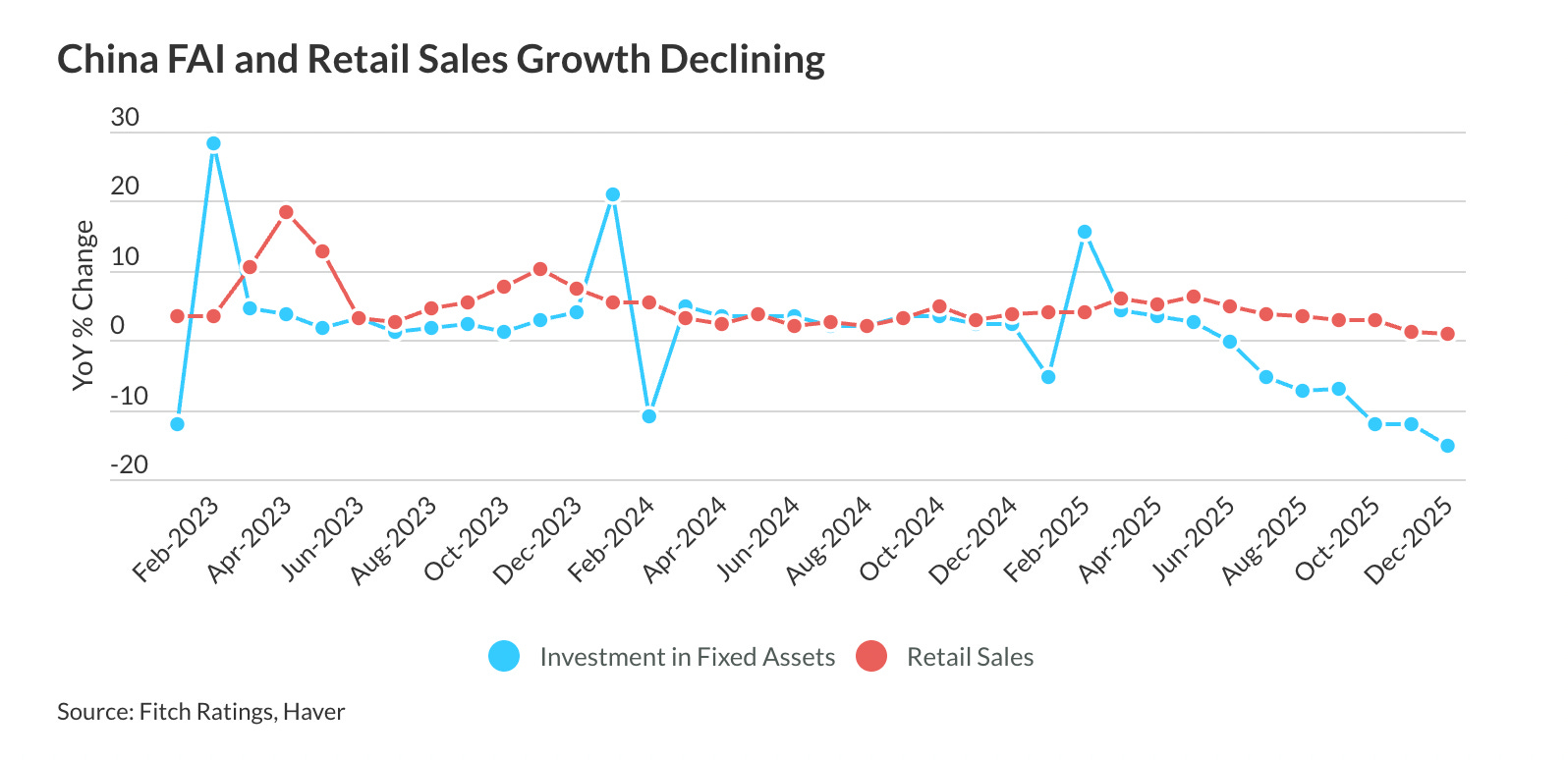
And a closer look reveals how, beyond exports, China’s economy isn’t looking very strong at all. Retail sales, for example, were up only 0.9 percent, and like GDP, were at a three-year low, the worst showing since the pandemic. They were also down from the 1.3 percent growth reported the previous month.
Fixed asset investment also disappointed, down 3.8 percent in 2025, the first full-year drop in decades. Much of that weakness was driven by the battered property market with investment in that sector down 17.2 percent. And private firm investment fell by 6.4 percent.
“Make domestic demand the main driving force”
If China can’t rely on export-led growth, where will it find a new growth driver? We heard the answer to that question from Xi Jinping on Tuesday. China will continue to “develop advanced manufacturing vigorously” (Xi is convinced China must avoid the hollowing out of industry seen in Japan and the U.S.), but crucially also will work to “make domestic demand the main driving force of economic growth,” Xi said.
Also that same day, China’s Ministry of Finance announced measures to boost consumption and investment. Those included a 500 billion yuan loan guarantee facility to encourage private companies to borrow as well as an annual interest subsidy of 1.5 percentage points on loans by small and medium enterprises for certain investments.
The government also says it’s going to expand public spending this year with a focus on boosting consumption and improving the well-being of the people. With those policy tail winds and what seems unanimous support inside the Chinese government, why am I still pessimistic?
Dual crisis of confidence
That’s because China needs to carry out some really significant reforms if it wants to overcome the dual crisis of confidence affecting both businesses and households. Along with creating a more level playing field for its private firms so they no longer are treated as second-class, it also must spend a lot more money on boosting education, healthcare and retirement benefits if it wants to make people start spending again (and neither looks very likely given Xi’s proclivity for state control and his fear that too much “welfarism” “encourages laziness,” as he has said in the past.)
Finally, an enormous obstacle to transitioning to a more demand-driven economy is the still ailing property sector, with prices continuing to fall in 2025. When the single largest asset that you own as a family keeps depreciating, you don’t feel confident nor ready to open your wallet and start spending, I told to Al Jazeera earlier this week.
“Constrained by sluggish consumer confidence”
“Domestic demand will remain constrained by sluggish consumer confidence, deflationary pressures, and investment headwinds that have broadened beyond the property-sector correction and are amplified by the local-government debt overhang,” writes Fitch Ratings, which is predicting just 4.1 percent growth this year.
“Policy efforts to reignite investment and shift towards greater consumption are likely to intensify, but on an incremental basis, providing modest support to economic activity.”
Keep reading with a 7-day free trial
Subscribe to Trade War to keep reading this post and get 7 days of free access to the full post archives.