Trade War
Newsletter 313 - Aug. 16, 2026
Welcome to the 313th edition of Trade War.
This week will be an abbreviated edition focusing on one important item of news.
The reason for this is that I am engaged in that great parent tradition of sending one’s child off to college. I am helping my daughter move into her college freshman dorm in Washington DC this week.
The passing of the great economic reformer Zhu Rongji
The big news this week is the passing of the great economic reformer Zhu Rongji, who died Wednesday after an illness at the age of 97.
Zhu, who served as vice premier then premier, the latter starting in 1998 and lasting until 2003, put an indelible imprint on the China of the 1990s and beyond. During those years when he served as the right hand man for President Jiang Zemin, Zhu faced down monumental economic challenges and carried out sweeping reforms of the Chinese economy. The most notable included:
Containing runaway inflation that at one point reached as high as 27 percent.
Reforming fiscal finances so that Beijing, or the center, would have more revenues to operate on, after clawing them back from the provinces. It was a policy that was necessary at the time, but later became problematic, as local governments become ever more reliant on selling land to make a buck.
Zhu privatized the state-owned housing stock in the late 1990s, the topic of one of the first articles I wrote where I examined his key role in reform. That move—taking the housing stock from the state enterprises and selling it a nominal rates to the workers—created the first extensive private housing market in China and was to eventually lead to the massive urban real estate boom that made so many Chinese wealthy over the years.
Zhu oversaw the downsizing of the massive state sector. That policy called Zhuada Fangxiao, or “grasp the large and release the small,” referred to the effort to marketize the very largest, most important state enterprises, often doing so by listing them on foreign exchanges, while ensuring the state still kept tight control. At the same time, Beijing was to let go of millions of smaller state enterprises, forcing them to fight to survive, with many going bankrupt.
Zhu also set off a process that saw tens of millions of Chinese lose their jobs.
A hundred coffins, 99 for corrupt officials…
Not surprisingly, many of these reforms, although arguably necessary, were not popular. Probably Zhu Rongji’s most famous line comes from 1998 when the People’s Daily reported him saying, “I have prepared a hundred coffins here, ninety-nine for corrupt officials and one for myself.”
Zhu seemed to be saying: I will continue with these sweeping reforms of the state sector, even as I face resistance from the many corrupt officials who have benefited from their power over these state enterprises, in the transition from the planned to the market economy. I am so determined that I will probably die trying to achieve this tough goal, therefore, the one last coffin for Zhu Rongji.
Not only was Zhu a great market reformer, he was charismatic, direct, and often intimidating. He was the object of constant attention of Chinese and foreign journalists, foreign diplomats, international business people, and economists, who followed his policies and his proclamations for many years.
That side of Zhu often surfaced during the press conferences he gave at the end of the annual Lianghui, or “Two Sessions,” including the Chinese People’s Political Consultative Conference and the National People’s Congress; it was a tradition for every premier to answer questions from reporters at the close of the annual meetings for almost three decades, until Xi Jinping ended it in 2024.
“Like a dead man”
One notable press conference he gave was happened on March 15, 1999. It was a sensitive time for China, coming shortly after the Asian Financial Crisis, at a time when many thought China was backtracking on reforms. And it came right before Zhu Rongji embarked on a trip to the U.S., which was then experiencing pretty strong anti-China sentiment. Zhu was going to the U.S. to try to jumpstart stalled negotiations regarding its entry to the WTO or World Trade Organization.
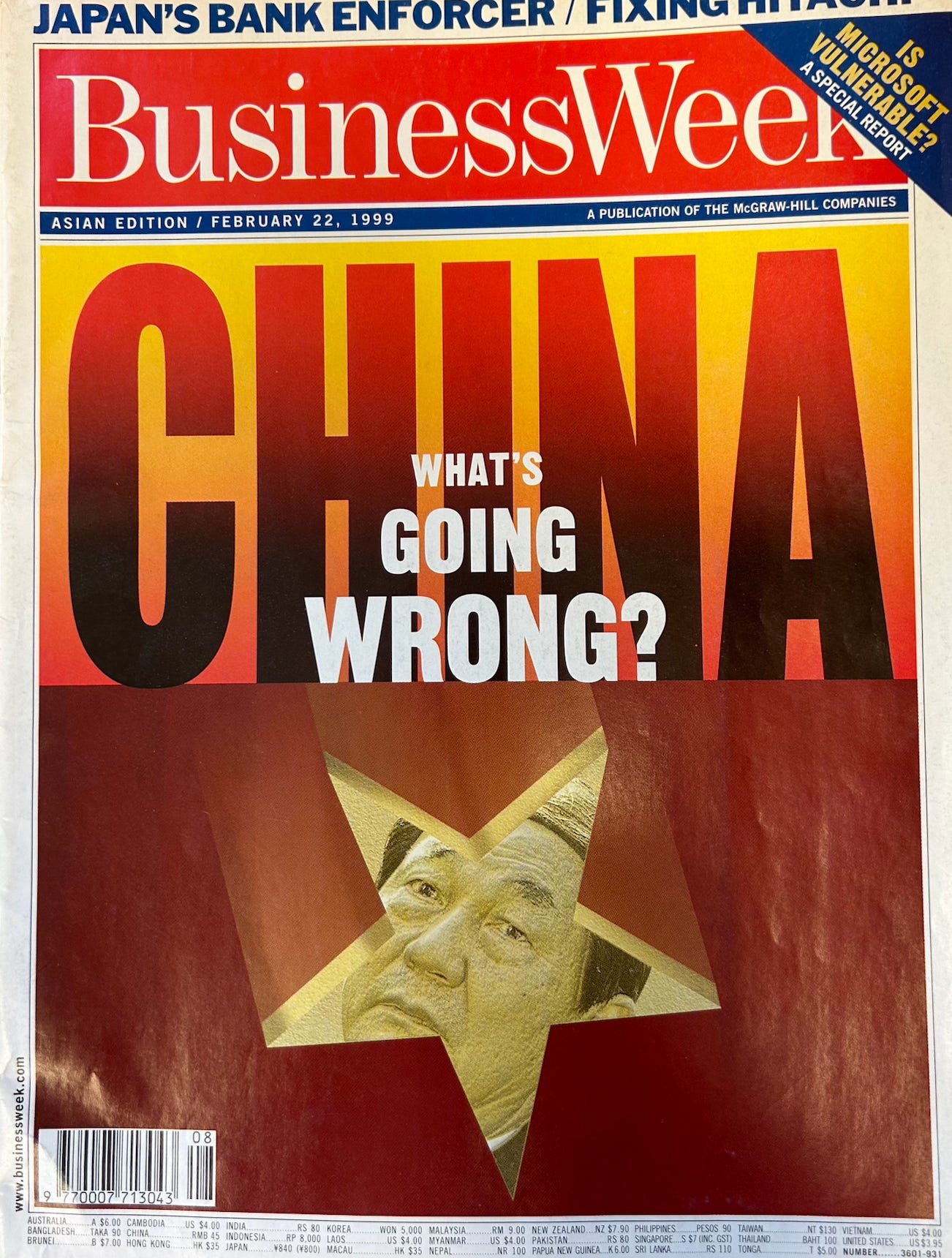
I had written a story in Business Week at the time with the title, “China, What’s Going Wrong?” that featured an image of Zhu on the cover. During the press conference, Zhu was asked whether he feared he might encounter a “hostile or unfriendly atmosphere” on his imminent trip to the U.S.
His answer in full (Chinese):
“A trend of opposition to China has emerged in the U.S., a development that deeply concerns us. I do not view my upcoming visit as stepping into a minefield, though I will certainly encounter a great deal of hostility and an unfriendly atmosphere. On February 22nd of this year, Business Week published an article titled, “China, What’s Going Wrong?”
“It was a rather unusual piece, suggesting that China was facing imminent disaster. I have not seen such an article in any other U.S. magazine. Its publication reflects the current trend in the United States where internal political struggles have effectively made Sino-U.S. relations a casualty. In this sense, I too have become a victim,” Zhu continued.
“The magazine featured a photo of me on its cover that made me look like a dead man. Naturally, visiting the U.S. in such an atmosphere is a daunting task, and many in the media have predicted that my visit cannot succeed. Yet, I am going anyway.”
Fair enough. I do think in retrospect that the cover was perhaps a bit over the top. The cover language was deliberately provocative and the cover image, showing the premier falling from the sky in a star, indeed, made Zhu “look like a dead man.”
A Reuters journalist and friend who was sitting next to me, quietly turned to me and flipped over my ID badge, displaying my name and affiliation at Business Week, so that neither were visible. He was being humorous, and it was rather funny. Another journalist, a former AFP photographer, told me later that he turned and focused his camera on my face, taking a bunch of pictures to see my reaction. According to him, I didn’t flinch.
Now, I can tell you I may not have flinched, but a lot was going through my head as I wondered what the repercussions would be of getting singled out by the premier. And what was the result? For about a year, we struggled to get any official interviews. They would either just turn us down without giving a reason, or sometimes say, “well, as the premier said, you do not seem to be very friendly to our country.”
Shaking hands in the Great Hall
Later, I did have the chance to shake Zhu’s hand in a lineup in the Great Hall of the People off of Tiananmen Square. He was not expecting me to be there and simply frowned back at me as I introduced myself. China, of course, did enter the World Trade Organization despite the challenges faced at home and in the U.S.
Entry to the WTO helped set off the massive economic boom that has improved the wellbeing of countless Chinese, made the country far more powerful, and turned China into the economic, trading, and technology superpower that it is today. None of that would have actually been possible without Zhu.
Today China, I’m afraid, is sadly lacking in leaders like him. Rest in peace, Zhu Rongji.
China’s What’s Going Wrong?” February 22, 1999